
Introduction
Across the world democratic systems are under stress. From Europe and the United States to India and Turkey, democracies have witnessed varying degrees of democratic backsliding, political polarization, and declining public trust in representative institutions. Pakistan is no exception. Yet Pakistan’s experience differs in important ways from other democracies because its political evolution has been shaped not only by electoral competition and civilian politics but also by the continuing role of the military in constructing, deconstructing, and reconstructing democratic institutions.
This essay explores three interrelated questions. First, how is democracy changing globally and how are these changes influencing Pakistan? Second, why has the military remained the pivotal institution in elite formation and political order? Third, why has Pakistan’s parliament failed to evolve into a robust institution capable of exercising effective oversight, representation, and accountability?
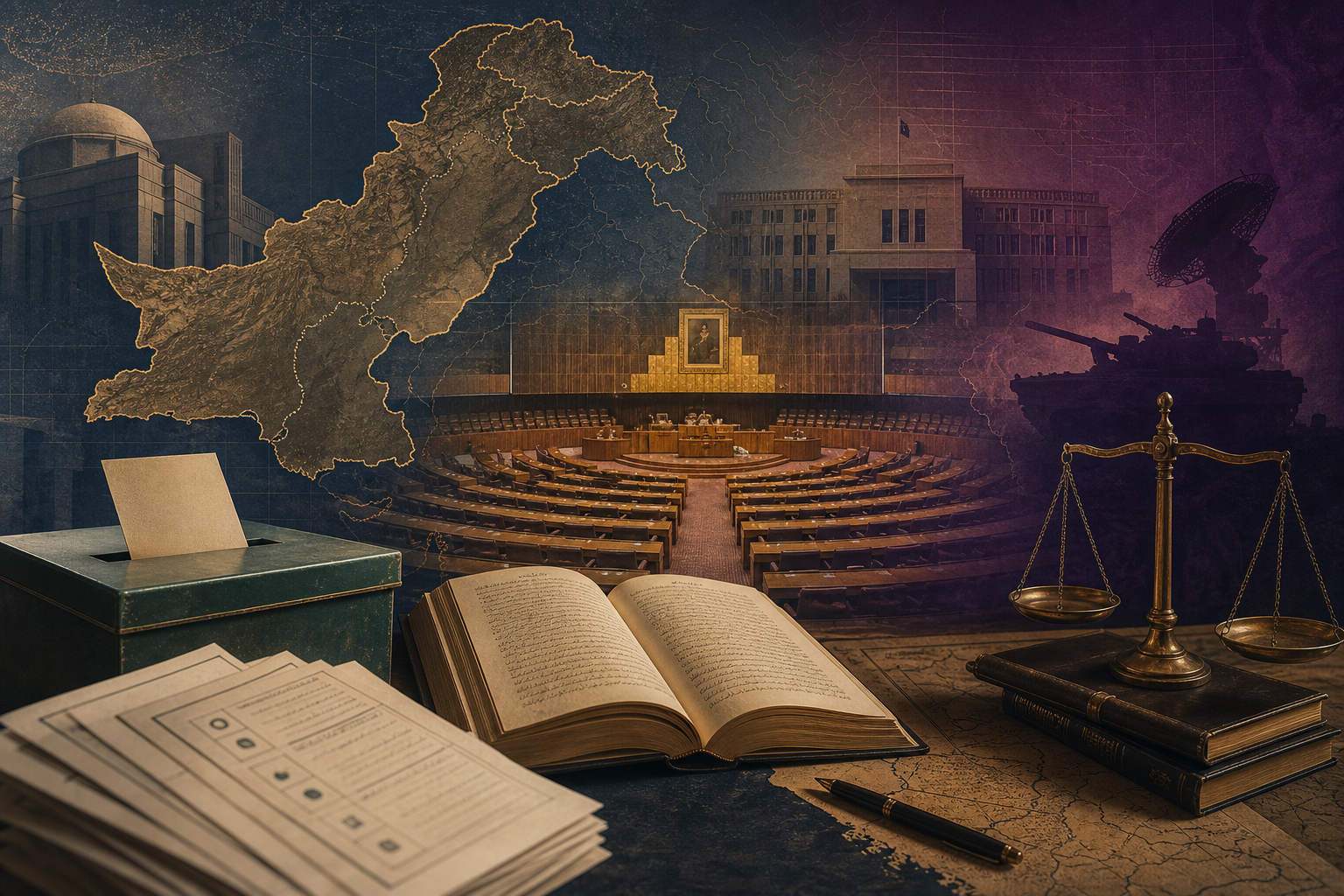
Three broad trends are reshaping democratic politics worldwide and are simultaneously transforming the character of democracy in Pakistan.
The first trend is democratic backsliding. Across many societies, social groups dissatisfied with the outcomes of globalization and the neoliberal economic order have mobilized behind populist and conservative political movements. These movements often display hostility toward pluralism, independent media, minority rights, and liberal democratic values. Political discourse increasingly revolves around grievance, identity, and exclusion rather than compromise and consensus. Consequently, democratic institutions remain formally intact while democratic norms and practices dwindle.
Pakistan reflects many of these tendencies. Rising inequality, religious polarization, weak governance, and declining trust in public institutions have contributed to an increasingly authoritarian political culture. Citizens continue to support democratic rule in principle, yet confidence in elected representatives and parliamentary institutions remains low. Political opportunism, shifting loyalties, and the absence of programmatic politics have further eroded the credibility of democratic governance.
The second trend is the transformative impact of technological innovation, particularly Artificial Intelligence, digital surveillance, and social media. These technologies have democratized access to information but have simultaneously intensified polarization, misinformation, and ideological conflict. Legislatures across the world face the challenge of balancing technological innovation, state security, and civil liberties. In Pakistan, parliament has yet to demonstrate the capacity to understand, regulate, and respond effectively to these profound technological changes. Instead of serving as a forum for informed debate and policy innovation, it often reacts to developments after they have already reshaped public discourse.
The third trend concerns security and geopolitics. Pakistan’s long rendezvous with terrorism, counterinsurgency operations, tensions with India, developments in Kashmir, and instability in Afghanistan have enhanced the strategic importance of the military. The return of the Taliban to power in Afghanistan in 2021 and the resurgence of Tehrik-i-Taliban Pakistan (TTP) have further elevated security concerns. As a result, the military’s institutional capacity, organizational coherence, and influence over strategic decision-making have expanded significantly.
These developments have reinforced a political order in which the military remains the principal guarantor of stability. While elections continue to be held and civilian governments regularly assume office, authority over strategic policy domains remains concentrated elsewhere. The result is neither direct military rule nor a fully functioning parliamentary democracy. Rather, Pakistan has evolved into a distinctive political arrangement that combines electoral politics with military predominance.
To understand this system, it is necessary to move beyond the widely used concept of “hybrid regimes.” The concept inadequately captures the historical and institutional realities of Pakistan. More than two decades ago, I proposed the concept of military hegemony to explain Pakistan’s political trajectory. Military hegemony refers to a system in which the military exercises dominant influence over strategic policy issues and key decision-making institutions while permitting varying degrees of civilian participation in governance. Such a system derives legitimacy from two sources. First, the military historically enjoyed greater public confidence than political parties and civilian institutions. Second, major external powers frequently treated the military as the principal strategic pillar of the Pakistani state, thereby reinforcing its domestic standing (Shafqat, Civil-Military Relations in Pakistan (1997). Although these foundations have weakened in recent years, particularly after the events of May 9, 2023, yet, the institutional structure of military hegemony remains largely intact.
Pakistan’s political history since 1958 can be understood as a recurring cycle of democratic deconstruction, construction, and reconstruction. Military governments introduced new political elites through mechanisms such as the Electoral Bodies Disqualification Order (EBDO), Basic Democracies, and the Legal Framework Order (LFO). Even during periods of civilian rule, the military retained substantial influence over strategic decision-making and elite formation.
The passage of the 27th Constitutional Amendment has further strengthened this framework by providing constitutional protection to arrangements that reinforce military predominance. Consequently, Pakistan’s political order increasingly reflects procedural rather than substantive democracy. Elections occur regularly, governments change, and constitutional processes continue, yet effective parliamentary oversight, institutional accountability, and citizen-centered governance remain inadequate.
The challenge, therefore, is not simply the restoration of democracy but the transformation of procedural democracy into substantive democracy. This requires strengthening representative institutions, improving parliamentary capacity, enhancing bureaucratic competence, protecting civil liberties, and creating mechanisms through which elected institutions can gradually acquire greater credibility and effectiveness.
This means, Pakistan’s political order cannot be understood through conventional democratic or authoritarian categories Since 2008, electoral competition has become regularized, civilian governments have completed terms, transfers of power have occurred through constitutional means, and representative institutions continue to function. Yet these developments have not produced democratic consolidation in the classical sense.
Democracy with Pakistani Characteristics
Pakistan’s experience points toward the emergence of what I would term, “Democracy with Pakistani Characteristics”: a political order characterized by the coexistence of electoral legitimacy, military predominance, weak institutionalization, fragmented political parties, and an increasingly restive citizenry. The system demonstrates continuity and adaptability, but its democratic content remains limited. This is reflected through such scholarly and extensively researched studies; Antol Lieven, Pakistan: A Hard Country (2011) and Christophe Jaffrelot, The Pakistan Paradox: Instability and Resilience (2015).
Eight Key Characteristics
The first defining characteristic is the regularization of electoral politics without corresponding institutionalization of democratic practices. Since 2008, elections have been held with reasonable regularity, elected governments have assumed office, and parliamentary institutions have continued to function. These developments have generated procedural legitimacy and reinforced public expectations regarding electoral participation. However, institutionalization has lagged behind electoral continuity. Political actors continue to view elections primarily as mechanisms for acquiring state power rather than instruments for strengthening democratic governance. Consequently, electoral competition has become routinized while democratic norms, accountability mechanisms, and institutional credibility remain fragile. The result is a political system where democracy survives procedurally but struggles substantively. Elections determine who governs but do not necessarily improve governance, accountability, or representation.
A second characteristic is the constrained effectiveness of institutions responsible for managing electoral competition. The Election Commission of Pakistan (ECP) has acquired constitutional significance and administrative responsibilities, yet questions regarding its autonomy, neutrality, enforcement capacity, and public credibility continue to persist. Political parties routinely challenge electoral outcomes, often questioning the neutrality of the ECP and electoral administration. Whether such claims are justified or exaggerated, the recurring contestation of electoral outcomes weakens institutional legitimacy and diminishes public confidence in democratic procedures. The challenge is therefore not merely conducting elections but creating broad-based confidence that electoral institutions operate impartially and possess the authority to enforce rules uniformly across political actors and nation -wide electoral constituencies.
The third feature concerns the organizational character of political parties. Political parties constitute the foundation of representative democracy. In Pakistan, however, parties remain highly personalized, centralized, and frequently dynastic. Leadership succession rarely follows institutional procedures. Decision-making authority is concentrated in a narrow circle of individuals or families. Candidate selection, policy formulation, and organizational management generally reflect personal authority rather than democratic consultation. Ironically, parties that demand democracy at the national level often fail to practice it internally. Consequently, parliament frequently reproduces elite interests (popularly described as elite capture) rather than serving as a channel for broader social representation. The persistence of dynastic leadership constrains the emergence of new political talent, limits ideological development, and weakens institutional continuity. The weakness of parliament is closely linked to the organizational structure of political parties. Political parties are expected to aggregate interests, recruit leadership, formulate policy alternatives, and provide channels through which citizens participate in governance. In Pakistan, however, parties often function as electoral vehicles centered around personalities, families, and patronage networks. Internal elections are infrequent, policy debates remain limited, and leadership succession is rarely institutionalized. Political loyalty frequently outweighs competence, expertise, or ideological commitment. This organizational weakness has significant consequences. It discourages the emergence of new leadership, inhibits policy innovation, and limits the capacity of parties to function as modern democratic institutions. Most importantly, parties that lack internal democracy find it difficult to nurture democratic practices within parliament and government.
A fourth characteristic is the capacity of elite institutions to accommodate one another. The military, judiciary, bureaucracy, and political leadership frequently compete for influence, yet they also possess strong incentives to avoid systemic breakdown. Periods of intense confrontation are commonly followed by phases of accommodation and adjustment. Recent constitutional developments illustrate this tendency. Rather than fundamentally altering the distribution of power, constitutional and political reforms increasingly codify existing relationships among major institutions. The outcome is neither democratic consolidation nor authoritarian restoration. Instead, the system evolves through negotiation, accommodation, and recalibration among competing elite actors. Such arrangements generate stability and durability, but they often do so at the expense of democratic deepening.
The fifth characteristic is the paradoxical relationship between political awareness and democratic values. Pakistan’s citizens are highly political. Electoral participation remains robust, political debates are widespread, and public engagement with national issues is intense. Social media has further expanded political expression, especially among younger generations. Yet political awareness does not automatically translate into democratic commitment. Respect for opposition, tolerance of dissent, protection of minority rights, adherence to constitutional norms, and acceptance of compromise and consensus remain unevenly developed. Politics often becomes an extension of religious, ethnic, linguistic, regional, or class identities. Under such circumstances, political mobilization strengthens participation but not necessarily democratic culture. The central challenge is therefore not political apathy but democratic socialization.
A sixth feature is the significant influence of external actors and transnational social networks. Pakistan’s large diaspora communities in North America, Europe, the Gulf States, and the Middle East shape domestic political discourse in important ways. These communities transmit competing political values and social norms. Diaspora populations residing in Western democracies often advocate constitutionalism, accountability, and political freedoms. By contrast, migration patterns linked to parts of the Gulf and broader Middle East have also contributed to the diffusion of more conservative religious and social orientations. Remittances, social networks, media consumption, and transnational activism increasingly influence political attitudes within Pakistan. Consequently, domestic democratic development is shaped not only by internal dynamics but also by competing external normative influences.
The seventh characteristic concerns the expanding yet constrained role of women in democratic politics. Women constitute nearly half of Pakistan’s population, but their representation within political institutions continues to depend significantly upon quota mechanisms introduced and expanded since 2002. Although quotas have increased numerical representation, candidate selection remains largely controlled by party leaderships. This limits the autonomy and political influence of many women legislators. Nonetheless, available evidence suggests that women parliamentarians have made important contributions, particularly in legislation concerning social welfare, education, health, child protection, and gender equality. Research, including Punjab Gender Parity Reports, indicates that women legislators often demonstrate greater engagement with citizen welfare issues than their male counterparts. Their participation therefore represents one of the most promising avenues for broadening the substantive content of Pakistani democracy.
Finally, underlying all these features is a deeper structural reality: military hegemony. Unlike many developing democracies, Pakistan’s political order evolved under conditions where one institution retained superior organizational coherence, coercive power, strategic capacity, and public legitimacy. Consequently, while political parties, parliament, bureaucracy, judiciary, and civil society have all expanded their roles, they have done so within a broader framework shaped by military predominance. The persistence of military hegemony ultimately rests not only on institutional power but also on performance perceptions. For decades the military was widely viewed as the most organized, disciplined, and effective institution in the country. Even when civilian governments enjoyed electoral legitimacy, public confidence in their ability to govern effectively frequently remained limited. Security crises, geopolitical tensions, counterterrorism operations, and regional instability further reinforced the military’s strategic significance. Consequently, civilian institutions seldom developed the confidence, cohesion, or capacity required to challenge military predominance directly. Instead, they adapted to it. This adaptation became a defining feature of Pakistan’s democratic evolution.
Military hegemony does not necessarily require direct military rule. Rather, it creates boundaries within which civilian politics operates. Governments change, elections occur, and political competition persists, but strategic policy domains remain influenced by an institution possessing superior organizational resources and coercive capacity. This reality explains why procedural democracy has survived while substantive democratization has remained constrained. Democracy with Pakistani Characteristics therefore represents neither a failed democracy nor a transitional hybrid regime. It is a distinct political order characterized by electoral continuity (despite disputes and outcomes of electoral results), institutional fragility, military predominance, limited democratic socialization, and persistent elite control. Its durability derives from its ability to combine popular participation with political management, electoral legitimacy with institutional weakness, and democratic aspiration with authoritarian tendencies.
The central question confronting Pakistan is whether this system can gradually evolve toward substantive democracy or whether it will continue reproducing procedural democracy without meaningful democratic deepening. If democracy with Pakistani characteristics suffers from weak institutionalization, limited parliamentary effectiveness, dynastic political parties, and military predominance, an important question emerges: why has this system endured?
The answer is: it lies in the interaction among three interrelated factors: military hegemony, elite institutional accommodation, and parliamentary underperformance. Together they have produced democracy with Pakistani characteristics; a political order that is resilient, adaptive, and capable of surviving repeated crises, yet remains resistant to substantive democratic transformation.
Since the restoration of electoral politics in 2008, Pakistan’s parliament has enjoyed a historic opportunity to establish itself as the principal arena for law-making, oversight, policy formulation, and national consensus-building. For the first time in the country’s history, elected governments completed their constitutional terms, transfers of power occurred through elections, and parliamentary continuity became normalized.
The adoption of the Eighteenth Constitutional Amendment in 2010 represented a landmark achievement. It restored parliamentary supremacy, enhanced provincial autonomy, strengthened federalism, and reversed many distortions introduced during periods of military rule. The amendment demonstrated that political parties could cooperate in pursuit of constitutional reform when faced with a common objective. Yet the momentum generated by the Eighteenth Amendment was not sustained. Instead of consolidating parliament as the supreme deliberative institution of the federation, political leaders increasingly reverted to executive-centered governance. In a recent doctoral dissertation, Dr. Maryam Ahmad has conceptualized it as Executive governance framework. Parliamentary committees remained underutilized, legislative scrutiny weakened, and meaningful debate on long-term national challenges became increasingly rare.
Issues such as climate change, educational reform, demographic pressures, technological transformation, religious extremism, provincial inequalities, water security, and human capital development received inadequate parliamentary attention despite their profound implications for Pakistan’s future.
The strength of parliamentary democracy rests on consultation, negotiation, compromise, and arguments-based consensus. Parliament is expected to reconcile competing interests through deliberation and dialogue rather than confrontation. In Pakistan, however, parliamentary politics increasingly became a continuation of electoral competition by other means. Opposition and government alike often prioritized tactical advantage over institutional strengthening. Parliamentary proceedings became arenas for political point-scoring rather than forums for policy deliberation.
Consequently, the credibility of parliament suffered. Citizens increasingly perceived political leaders as engaged in perpetual conflict while remaining disconnected from governance challenges confronting ordinary people. This decline in deliberative politics weakened parliament’s claim to institutional authority and created space for non-elected institutions to assume greater prominence.
The foregoing analysis suggests that Pakistan’s challenge is not the absence of democracy but the limited capacity of democratic institutions to govern effectively. If Pakistan is characterized by a system of military hegemony operating alongside electoral politics, the challenge is not to deny this reality but to work within it to strengthen democratic institutions. Sustainable democratization requires an evolutionary rather than revolutionary approach. The objective should be to transform procedural democracy into substantive democracy by enhancing institutional competence, expanding participation, and strengthening mechanisms of accountability.
Reform Agenda
A realistic reform agenda must therefore focus on institutions rather than personalities and governance rhetoric.
The first priority should be the reconstruction of state capacity. No democratic system can function effectively without a professional, competent, and politically neutral bureaucracy. Across the federal and provincial levels, Pakistan’s administrative institutions have suffered from politicization, declining professional standards, weak recruitment systems, and inadequate training mechanisms. Reforming the Federal Public Service Commission and Provincial Public Service Commissions should become a national priority. Recruitment must be merit-based, transparent, and responsive to the changing requirements of governance in the twenty-first century. Equally important is the modernization of training institutions so that public servants acquire expertise in public policy, digital governance, climate adaptation, technological regulation, conflict management, and service delivery. Historically, Pakistan’s bureaucracy provided continuity and administrative coherence. Revitalizing this capacity is essential for both democratic development and economic modernization.
The second priority is strengthening parliament as a working institution rather than merely a representative forum. Parliamentary committees constitute the backbone of effective legislatures throughout the world. They provide opportunities for detailed scrutiny of legislation, policy evaluation, expert consultation, and executive oversight. In Pakistan, however, committees remain underutilized and often lack adequate research support. Their recommendations frequently receive limited attention from the executive branch. A meaningful reform strategy would empower parliamentary committees through enhanced research capacity, professional staffing, access to independent expertise, and mandatory review of major legislation. Such reforms would gradually reduce reliance on executive ordinances and administrative decrees while strengthening legislative ownership of public policy. The objective should be to transform parliament from a forum of political confrontation into an institution of informed deliberation.
The third priority concerns the consolidation of federalism. The Eighteenth Amendment fundamentally altered the relationship between the federation and the provinces by transferring substantial authority to provincial governments. Yet institutional mechanisms required to manage this transformation remain underdeveloped. The Ministry of Inter-Provincial Coordination should be strengthened and reoriented toward facilitating cooperation among provincial governments, provincial legislatures, and federal institutions. Its role should extend beyond administrative coordination to include policy harmonization, conflict resolution, and collaborative planning. A federal system functions effectively when institutions encourage cooperation rather than rivalry among different tiers of government. Strengthening these mechanisms is essential for national cohesion and effective governance.
The fourth priority is the institutionalization of the Council of Common Interests (CCI). The CCI represents perhaps the most important yet underutilized institution created by the constitutional framework. It provides a forum through which the federation and provinces can collectively deliberate upon issues of national importance. Regular meetings, systematic agenda-setting, a strengthened secretariat, and greater transparency in decision-making would enable the CCI to become the principal mechanism for managing intergovernmental relations. In an increasingly diverse and decentralized Pakistan, the CCI should evolve into the central coordinating institution of the federation. Its strengthening would reduce provincial grievances, improve policy coordination, and enhance democratic legitimacy.
The fifth priority concerns political parties themselves. No democratic system can become more democratic than its principal political organizations. Internal party elections, transparent financing, merit-based candidate selection, and leadership renewal are essential prerequisites for democratic consolidation. Political parties should be encouraged to establish institutional mechanisms through which women, youth, labor representatives, professionals, and civil society actors can participate meaningfully in decision-making processes. Democratizing political parties is perhaps the most difficult reform challenge, but it remains indispensable for strengthening democracy. A National Political Reform Forum involving political parties, parliamentarians, academics, labor organizations, women’s groups, and youth representatives could provide a platform for discussing institutional reforms that transcend partisan divisions.
The sixth priority is strengthening knowledge-based governance. The Pakistan Institute for Parliamentary Services (PIPS) represented an important innovation aimed at enhancing legislative capacity. However, its potential remains underutilized. PIPS should evolve into a premier parliamentary research institution capable of providing legislators with rigorous policy analysis, legislative drafting support, comparative research, and data-driven policy recommendations. As governance challenges become increasingly complex; from artificial intelligence and climate change to demographic pressures and economic restructuring…parliamentarians require access to specialized expertise. Without such support, legislatures will remain dependent upon the executive bureaucracy for information and policy guidance.
The seventh and perhaps most neglected priority is local government. One of the enduring contradictions of Pakistani politics is that leaders consistently advocate democracy while resisting meaningful devolution of authority to local institutions. The Eighteenth Amendment recognized local government as an integral component of the constitutional order. Yet provincial governments across the political spectrum have shown reluctance to establish autonomous and empowered local institutions. Effective local governments bring governance closer to citizens, improve service delivery, enhance accountability, and create opportunities for new leadership to emerge. The future of democratic development in Pakistan depends not only upon strengthening parliament but also upon creating vibrant institutions of local representation and participation.
Concluding Thought
Pakistan’s democratic journey has been marked by cycles of construction, deconstruction, and reconstruction. Since 2008, the country has achieved a measure of constitutional continuity and electoral regularity that was absent for much of its history. Yet democratic consolidation remains incomplete. This essay has argued that Pakistan has evolved into a distinctive political order; Democracy with Pakistani Characteristics. This system combines electoral competition with military hegemony, political participation with institutional fragility, and democratic aspirations with authoritarian tendencies. Its resilience derives from elite accommodation, military predominance, weak political parties, and limited parliamentary effectiveness. Its weakness lies in its inability to convert procedural legitimacy into substantive democratic governance. The prevailing description of Pakistan as a hybrid regime captures some aspects of this reality but fails to explain its durability. Hybrid regimes are generally understood as transitional arrangements existing between authoritarianism and democracy. Pakistan’s experience suggests something different. The system has demonstrated remarkable continuity over several decades. Rather than moving steadily toward either democratic consolidation or authoritarian reversal, it has evolved into a managed democratic order characterized by electoral competition, constitutional continuity, military predominance, and elite accommodation. This arrangement has succeeded in preserving political order and preventing systemic collapse.
The future of democracy in Pakistan therefore depends less on constitutional engineering and more on institutional development. Stronger bureaucracies, more effective legislatures, empowered provinces, functional local governments, democratic political parties, and knowledge-based policy making are essential components of this transformation. Equally important is the recognition that democracy cannot be reduced to elections alone. Democracy flourishes when institutions cultivate trust, encourage participation, protect dissent, promote accountability, and deliver public goods effectively. The central challenge facing Pakistan is not whether democracy will survive. Public commitment to elected government remains strong. The challenge is whether democratic institutions can acquire sufficient capacity, credibility, and legitimacy to govern effectively within a political order historically shaped by military hegemony. The central paradox of democracy with Pakistani characteristics is therefore clear: the system has proven sufficiently stable to survive, but insufficiently democratic to transform itself. Until parliament, political parties, and civilian institutions acquire greater organizational capacity, credibility, and public trust, military hegemony is likely to remain the defining feature of democracy with Pakistani characteristics.
Also available: https://www.thefridaytimes.com/08-Jun-2026/beyond-hybrid-regimes-making-democracy-pakistani-characteristics
Discussion
Join the conversation. Comments are powered by GitHub Discussions.