
Introduction:
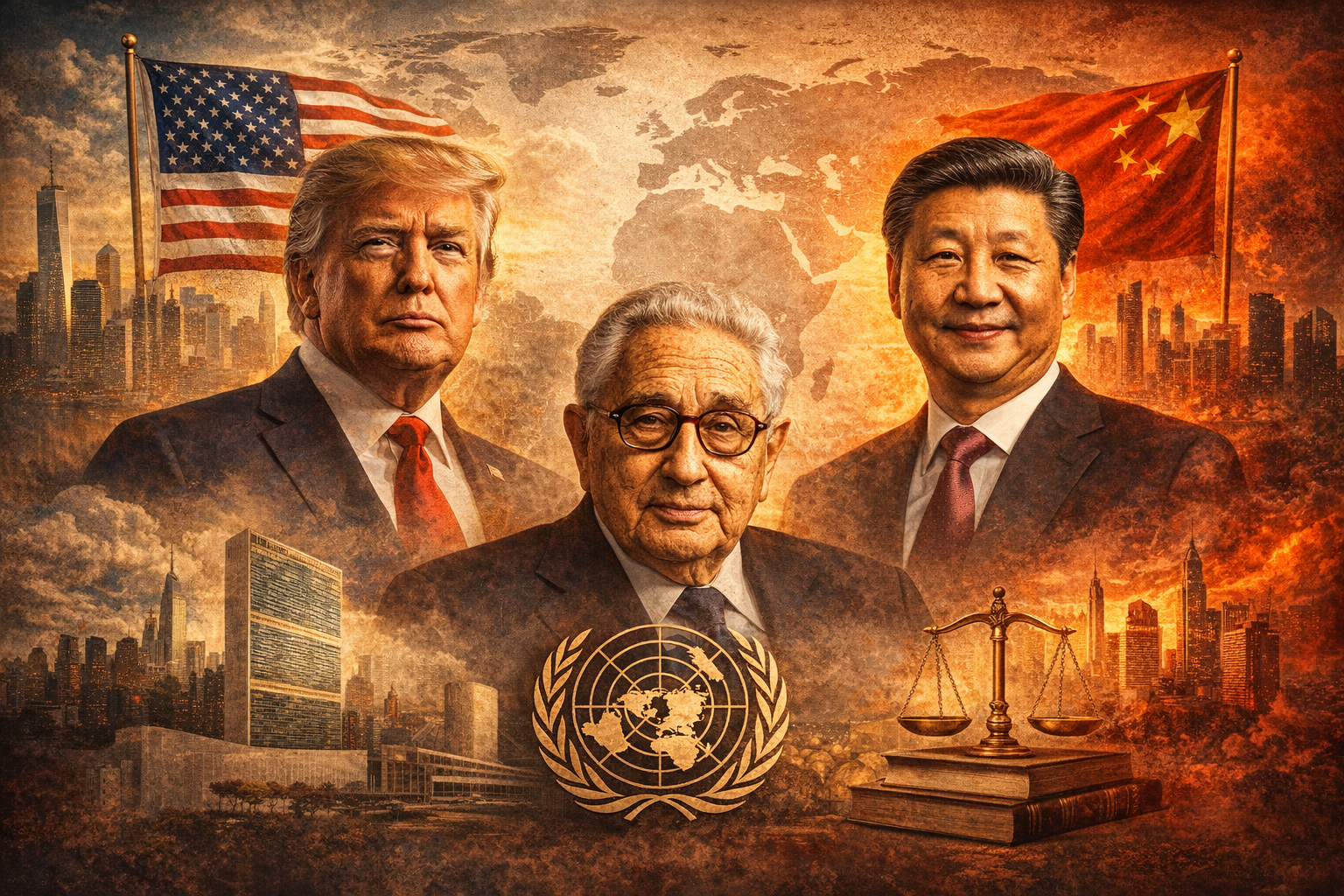
The study of U.S-China relations increasingly reveal the importance of leadership style and strategic culture in shaping global order. In my view, a comparative reflection on Henry Kissinger, Donald Trump, and Xi Jinping offers a useful analytical lens to understand contemporary great power competition.
Why it Matters?
Kissinger’s diplomatic philosophy was that of a classical realist, emphasizing balance of power, strategic restraint, and incrementalism (step by step approach). His ‘shuttle diplomacy’ epitomized as diplomacy personified. Yet, he prioritized order and system stability over ideological confrontation, and he demonstrated a high tolerance for ambiguity and gradualism (Indyk, Martin. Master of the Game: Henry Kissinger and the Art of Middle East Diplomacy 2021, Kissinger, Henry. On China. 2011) Contrarily, U.S. policy under president Donald Trump reflects an unpredictable, disruptive and transactional leadership style, marked by bilateralism, incredulity toward alliances and the UN system, and the use of economic coercion; principally in the form of tariffs and trade wars against China and most of the world. Trump’s approach signaled a departure from institutionalized diplomacy toward a loyalty driven personalized and immediate pursuit of national advantage (America first, MAGA)
Xi Jinping, on the other hand, represents a coherently centralized, long-term and state-centric strategic vision (Kevin Rudd, On Xi-Jinping… 2024) His leadership emphasizes national rejuvenation, technological self-reliance, and expansion of China’s global influence through initiatives such as the Belt and Road Initiative. Unlike the reactive and often short-term orientation of Trump’s policies, Xi’s strategy is systematic and future-oriented, integrating economic, political, and military instruments of power.
Implications for the Global Order:
A key distinction between U.S. and Chinese strategic behavior lies in their approach to building a world order. The United States, particularly in the Kissingerian tradition, has sought to manage and stabilize regions through alliances and diplomatic engagement, even while pursuing dominance. Trump, instead has chosen to devalue alliances and multilateralism and relied on displaying and unleashing the U.S military might. China, under Xi, appears to prefer to operate under the existing institutional frameworks and economic connectivity/interdependence, implicitly reshaping global order without direct confrontation with the U.S.
Another dimension concerns the role of ideology. While Kissinger downplayed ideological considerations in favor of Realpolitik, contemporary U.S.–China rivalry increasingly exhibits (in the U.S case) ideological connotations, particularly around governance models, technology, and global norms. However, China’s approach remains prudent; a reluctant great power but pragmatic than doctrinaire, blending state control with economic globalization.
In strategic terms, U.S. behavior has oscillated between engagement and containment, whereas China has pursued a strategy of crafefully crafted integration and strategic expansion (15th Five Year Plan). This asymmetry reflects deeper differences in political systems, historical experiences, and leadership worldviews.
Concluding Thought:
Leadership styles matter profoundly. Kissinger’s legacy illustrates the power of strategic patience and calibrated diplomacy (that Xi appears to have embraced), Trump’s on-going strategy accentuates the impact of disruptive unilateralism, and Xi Jinping’s approach highlights the role of coherent centralization and long-term planning and strategic vision. Together, these models illuminate the evolving contours of U.S.–China competition and the challenges of constructing a stable global order during this decade. The rescheduled visit (May 14-15, 2026) of Trump to China and meeting with Xi could set the tone, direction and agenda in shaping the contours of the world order, however, if U.S/Israel ground forces invade Iran, the global order could enter unknowable arena!
Discussion
Join the conversation. Comments are powered by GitHub Discussions.