
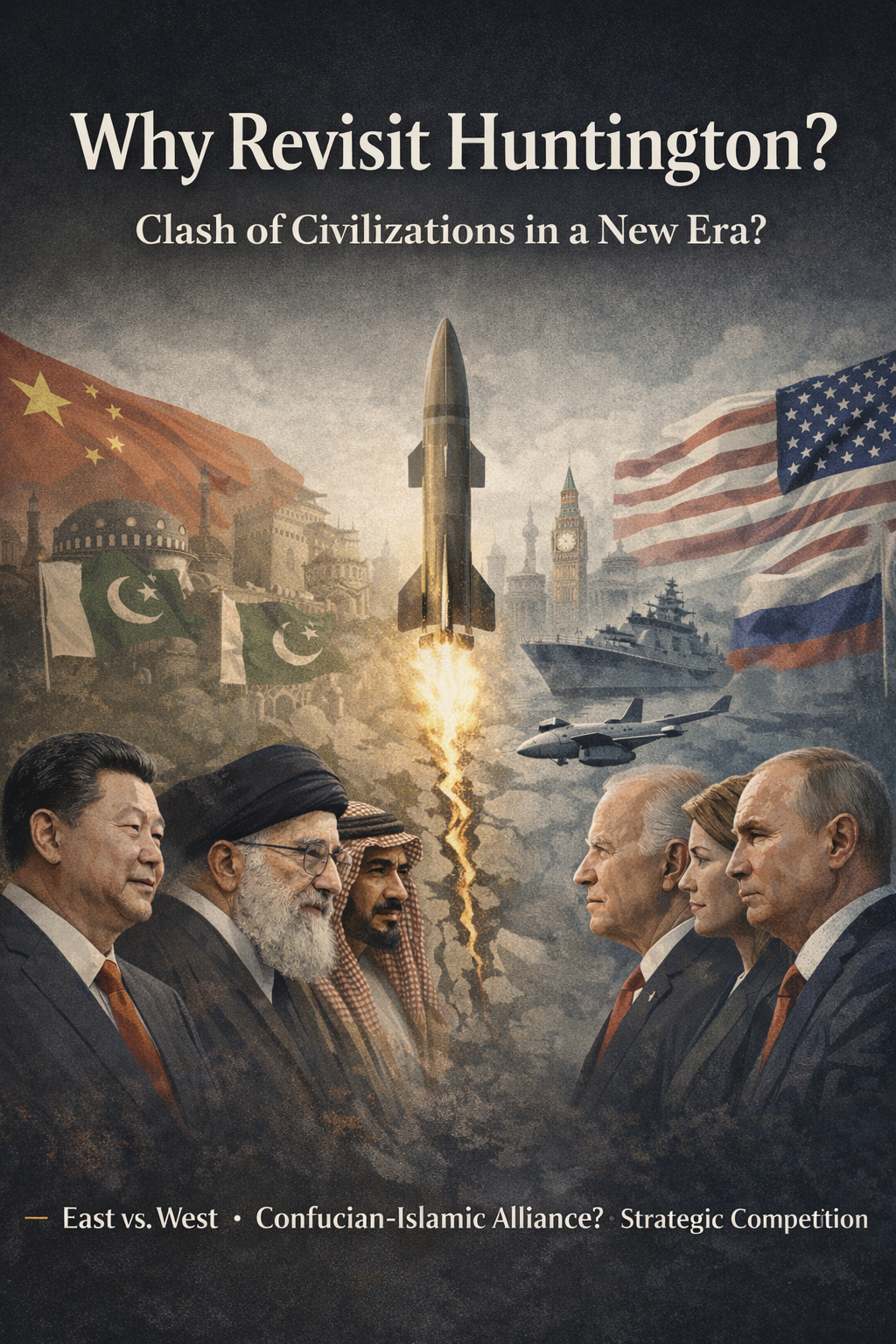
Why Revisit Huntington?
Samuel P. Huntington (1927-2008), an influential American scholar and strategic thinker, advanced a provocative thesis in his widely discussed article, “The Clash of Civilizations?” published in Foreign Affairs (September 1993).
He hypothesized a potential alignment between Confucian and Islamic states (think Gulf states, Pakistan, and beyond) and outlined how the West might counter such a development. Huntington clarified that emerging tensions were not necessarily a civilizational clash in a pure cultural sense, but rather a strategic conflict in which civilizations functioned as identity markers.
In this framework, non-Western societies, framed as the “West versus the Rest,” could evolve into strategic competitors and therefore be contained.
Strategic Core of the Argument
Huntington argued that China was not only advancing economically and expanding diplomatically, but also emerging as a challenger to U.S. military power and global predominance. He located China’s rise within a civilizational context, grounded in values and historical traditions different from those of the West.
He observed that a central focus of conflict could emerge between the West and several Islamic-Confucian states. He conceptualized this conflict in terms of arms competition, including nuclear capabilities, missile development, and transfer of advanced military technologies.
Accordingly, Huntington argued that Western strategy should operate on both short-term and long-term goals. In the short term, while strengthening alliances across Europe (including Russia), he offered the following sweeping prescription:
“Incorporate into the West societies in Eastern Europe and Latin America whose cultures are close to those of the West; promote and maintain cooperative relations with Russia and Japan; prevent the escalation of local inter-civilization conflicts into major inter-civilization wars; limit the expansion of the military strength of Confucian and Islamic states; moderate the reduction of Western military capabilities and maintain military superiority in East and Southwest Asia; exploit differences and conflicts among Confucian and Islamic states; support in other civilizations groups sympathetic to Western values and interests; strengthen international institutions that reflect and legitimate Western interests and values; and promote the involvement of non-Western states in those institutions.”
Contemporary Question
From the signing of the Abraham Accords in September 2020 to the current Israel-U.S.-Iran crisis context (February 2026 onward), an important question arises: are these developments merely tactical responses aimed at containing or punishing Iran, or do they reflect a broader U.S. effort to pre-empt or disrupt a perceived Confucian-Islamic convergence?
I do not claim a definitive answer. However, it remains important to ask whether Chinese academics and policymakers perceive such convergence as limited to energy security, supply chains, and safeguarding investments, or as something deeper.
Concluding Reflection
This question invites deeper reflection on whether Huntington’s civilizational framing still informs strategic thinking in Washington, and whether contemporary alignments in the Middle East and beyond are increasingly shaped by the logic of preventing cross-civilizational collaboration.
Discussion
Join the conversation. Comments are powered by GitHub Discussions.