
Context
Amitav Acharya, Distinguished Professor at American University, has for over a decade been a leading voice in International Relations and global politics. He introduced the concept of the “multiplex world” and, in addition to his contributions to IR theory, has authored several books on world politics, including The Once and the Future World Order (2025).
His central argument is that non-Western civilizations, including India, China, and Africa, have long contributed to international order. As Western dominance declines, he sees the emergence of a more inclusive world order. On February 19, 2026, he gave a wide-ranging interview to Ross Douthat of The New York Times on changing dynamics in world politics.
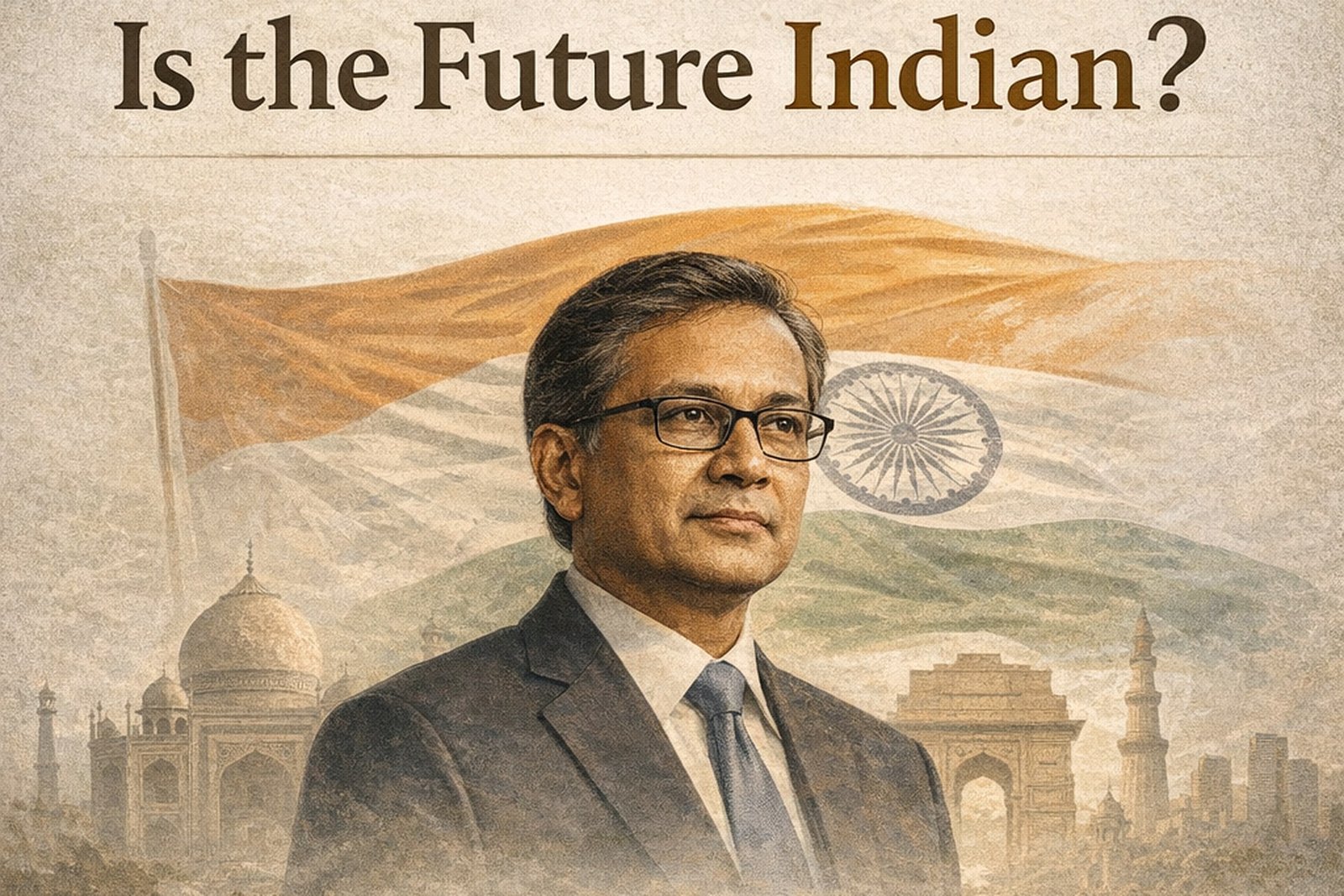
Acharya advanced the proposition that “the future is Indian” and situated it within a long historical arc while recognizing interconnections among trade, commerce, security, economy, demography, and diaspora.
India, China, and the U.S.
Taking a longitudinal view of history, Acharya argues that Indian civilization historically extended from the Indus to the Steppes and Persia, invoking a civilizational dimension of Indian power much as China does.
Differentiating Chinese and Indian pathways to economic development and political prominence, he noted that in the 1950s India appeared to have comparable potential, but China surged ahead. Today, however, he suggests India can chart its path through appropriate development policies and integration into global supply chains.
Having lived in China for two decades, Acharya observes that China has moved from low-cost manufacturing to high-technology industrial capability. He contends that China seeks top-tier global status and may eventually displace the United States in parts of the international order, even if this is not openly stated.
By contrast, he argues India seeks status and respect rather than dominance. This raises an important question for South Asia: can India sustain the image of a benign power while pursuing harder strategic interests in the region?
Indian Diaspora: The Intellectual Powerhouse
Acharya underscores the growing influence of the Indian diaspora as a source of resilience and soft power. Its skills and professionalism, especially in universities, media, arts, and culture, have strengthened India’s standing in the United States, the United Kingdom, and the wider Western world.
In his assessment, opportunities remain promising in Australia, Canada, and the United States, while Europe appears more constrained. The diaspora’s intellectual and cultural presence reinforces the broader narrative of India’s rise and embeds it in policy and public discourse.
1971 Memory, and Relations with China, the U.S., and Russia
A third dimension of the interview concerns the 1971 India-Pakistan war and enduring warmth in India toward Russia. Though an American/Canadian citizen of Indian descent, Acharya describes 1971 as a turning point, recalling how President Nixon and Henry Kissinger deployed the Seventh Fleet in the Bay of Bengal, prompting India to conclude a defense treaty with the Soviet Union.
He maintains that India was historically non-aligned and is now multi-aligned. On Russia under Putin, he notes India’s energy dependence, though he believes this could evolve. On China-Pakistan relations, he observes that many Indians find Chinese support for Pakistan irksome, yet argues that India and China can still sustain transactional relations.
He does not treat India and Pakistan as co-equals, even though both are nuclear powers. He is mindful, however, that domestic stresses in both countries can sap national energy and that war would be devastating for human development and regional stability.
Concluding Thought
From the interview and related discourse, it appears that the West, particularly the United States, views India as a potential torch-bearer of democracy and capitalism at a time of demographic decline and relative retrenchment in Western societies. With a youthful population and sustained growth, India is frequently projected as a strategic alternative to China.
Yet Acharya also makes clear that India will not rely exclusively on the United States. While the Indian diaspora projects intellectual influence and cultural presence, the long-term proposition that “the future is Indian” will remain constrained unless disputes with neighbors, particularly Pakistan, are addressed with seriousness and continuity.
Discussion
Join the conversation. Comments are powered by GitHub Discussions.