
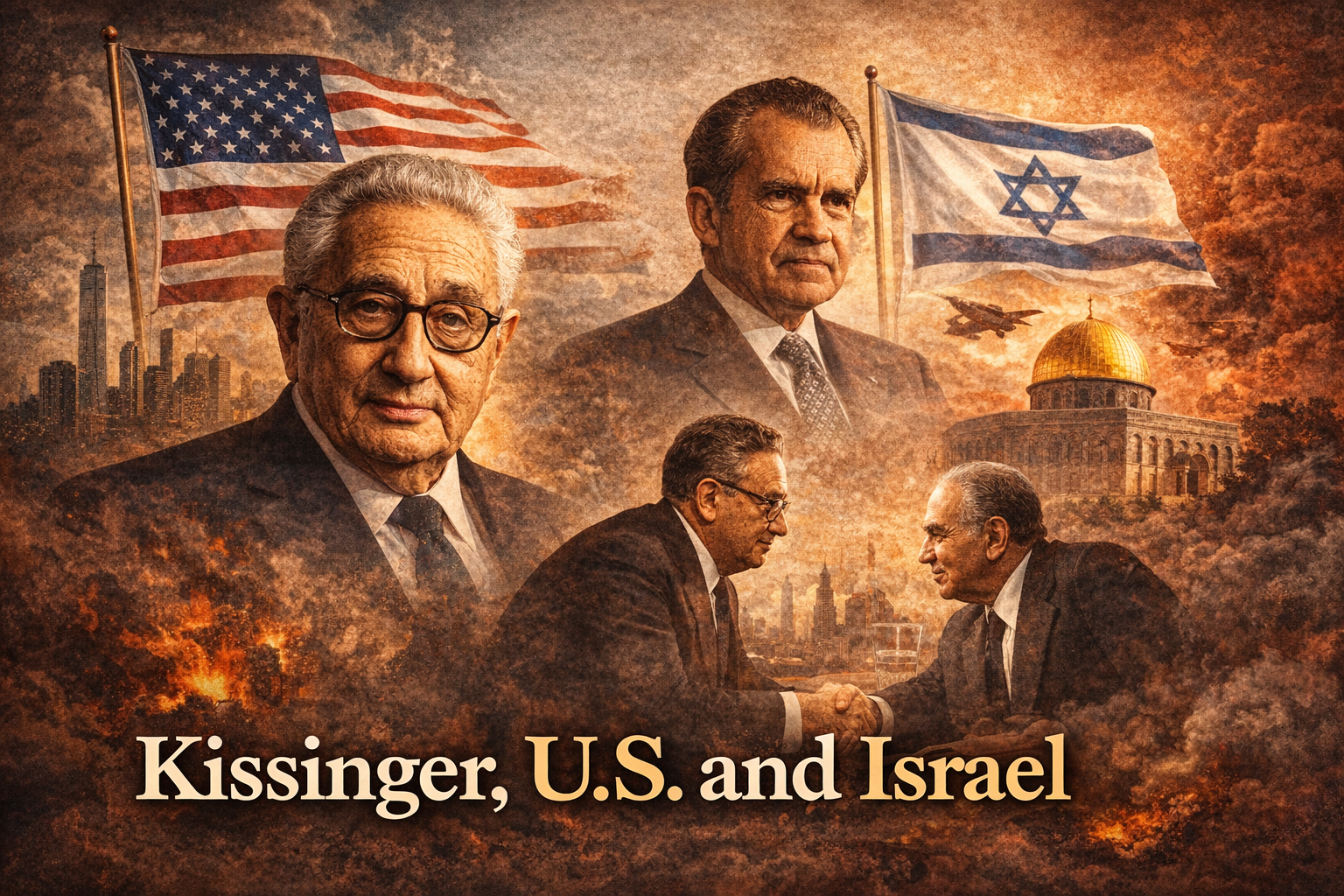
Kissinger, U.S and Israel:
In continuation of my earlier Blog note dated April 4, to have a better understanding pf leadership behavior and unwavering U.S support for Israel, I reread Henry Kissinger, book Years of Upheaval (1982), chapter xi The Middle East War, Pages 450-544.
Why it Matters?
Kissinger makes clear that by 1973 the United States had become Israel’s indispensable strategic partner; both militarily and diplomatically, to the discomfort of Europe. He emphasizes the U.S. airlift during the war and subsequent diplomatic shielding. However, he frames this not as unconditional ideological alignment (unlike today), but as a Cold War necessity to counter Soviet influence in Arab states (pp. 460–470) Kissinger unequivocally states that Yom Kippur War was initiated by Egypt and Syria in a coordinated, premeditated attack (pp. 450–451). He underscores Israel’s strategic surprise, noting the improbability of Israel launching a war on Yom Kippur, the holiest Jewish day.
It is pertinent to note that despite early Arab battlefield successes, Kissinger’s diplomacy aimed to restore and preserve Israel’s military dominance. Through ceasefire negotiations and post-war arrangements, he sought to prevent a decisive Arab victory while avoiding total Arab humiliation; thereby enabling future diplomacy (pp.500–520). His “step-by-step diplomacy” fostered ties with Saudi Arabia and Jordan to align them gradually with U.S. influence.
What are its Implications?
Kissinger deliberately relegated the Palestinian issue, treating it as too destabilizing for immediate settlement (not too different from present day situation). He sharpened focus on state-to-state diplomacy (Egypt, Syria, Jordan). While he did not explicitly advocate permanent Israeli retention of all 1967 territories, his incrementalism effectively postponed territorial resolution, allowing Israel to consolidate control after the Six-Day War (pp. 530–540).
Kissinger confirms that Richard Nixon instructed that U.S. policy must ensure Israel’s survival and credibility as an ally. This directive shaped the emergency resupply effort and diplomatic posture (pp. 455–460). However, Kissinger balanced this with maintaining relations with key Arab states. Of course, direct attack on Iran was not central to Kissinger ‘s 1973 strategic design.
Concluding Thought:
As a concluding thought in my assessment; extending Kissinger’s 1973 framework to the present, it is analytically plausible, though not exact, we need to see a modified continuity in U.S.–Israel strategy, now recalibrated around China rather than the Soviet Union. The argument of continuity is persuasive only when adapted to a transformed strategic environment in which China and not the Soviet Union figures as the principal systemic rival, yet one that is markedly more cautious and economically interdependent with the United States. Much like Kissinger’s effort to preserve Israel’s security while orchestrating a broader regional alignment, contemporary U.S. policy continues to sustain Israel’s military superiority and cultivate tacit or overt accommodation from Arab states; however, China’s posture diverges sharply from Cold War Soviet activism. Beijing is deeply embedded in trade, energy, and infrastructure partnerships across the Middle East, including with Saudi Arabia and Iran and prioritizes regional stability to safeguard these interests, showing little appetite for direct military confrontation with Washington. In this sense, while a structural echo of Kissingerian balance-of-power logic persists, the contemporary order is less about bipolar rivalry and more about managed competition, where China acts as a prudent but risk-averse great power- seeking de-escalation, stability and order rather than escalation, thereby complicating but not overturning U.S. efforts to maintain a favorable regional balance anchored in Israel’s supremacy and military might. Consequently,
any alignment of Arab states with U.S.–Israel objectives vis-à-vis Iran is less likely to take the form of overt military coalition-building and more a pattern of cautious, interest-driven convergence, reflecting both regional pragmatism and China’s preference for a stable, non-polarized Middle East. These augurs promising for peace but the looming threats of escalation and turning Iran into, ‘stone ages’ could inflame the entire Middle East into a towering inferno and what is happening to global economy is unfolding on daily basis and disrupting citizens life across the world…
Discussion
Join the conversation. Comments are powered by GitHub Discussions.