
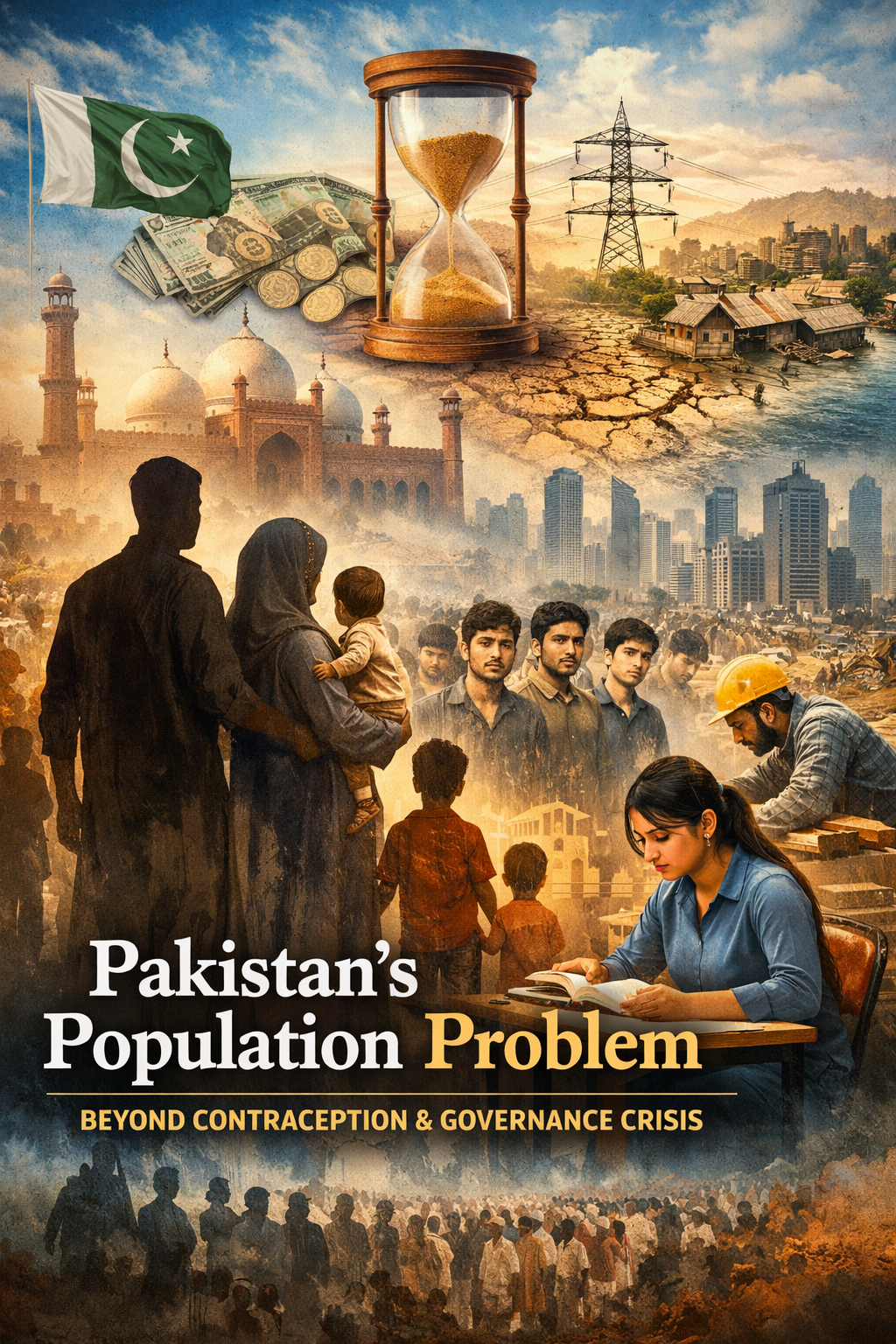
Context: Population Growth: Policy Paradox or Puzzle
For decades, Pakistan’s population debate has revolved around family planning. The assumption is simple: expand contraceptive access, and fertility will decline. But after thirty years of such thinking, Pakistan’s population has grown from 126 million in 1994 to more than 240 million today. The problem is not merely about contraception and unmet need. It is about governance.
When world leaders met in Cairo in 1994 to reframe population as a development issue, Pakistan’s Prime Minister, Benazir Bhutto, endorsed a vision of reproductive rights and human dignity. Yet three decades later, Pakistan still struggles with high fertility, the highest in South Asia, alongside chronic fiscal crises, youth unemployment, and climate vulnerability.
Why Does it Matter?
It matters because almost 60% of Pakistan’s population is under 30. Each year, millions of young people enter a labor market that cannot absorb them. Public schools are overcrowded and private schools are money fleecing shops. Child stunting affects roughly 40% of children. Learning poverty remains staggeringly high. Rapid urbanization has overwhelmed city infrastructure. Climate shocks; from floods to heatwaves, hit ever-denser populations in rural areas and urban shanty towns. Population growth acts as a challenge multiplier. It
intensifies ushering governance crisis. Family planning programs have existed for decades. Many were technically sound. But governance fragmentation—especially after devolution—undermined coordination and continuity. More importantly, fertility behavior in Pakistan is shaped by social norms. In many communities, marriage implies childbirth within a year and male preference is a life ambition. Contraception carries stigma. Women’s economic participation remains limited. These, are not medical problems. They are cultural and institutional ones.
Countries that successfully reduced fertility—South Korea, Bangladesh, even Iran, did so not only through clinics but through female education, labor-force integration, and sustained policy commitment across political cycles. Pakistan must do the same.
The World Bank Group (2025) Country Partnership Framework for Pakistan 2026–2036 has identified stunting, learning poverty, climate resilience, and private investment as key development goals. None of these can succeed if demographic expansion continues to outpace institutional capacity.
What would a governance-centered demographic strategy look like?
First, enforce universal education by operationalizing Article 125 A (especially for girls). The Article states: The state shall provide free and compulsory education to all children of the age five to 16 years.
Second, create economic incentives for delayed marriage and smaller families.
Third, integrate demographic projections into urban and climate planning.
Fourth, use digital technology and AI to monitor service delivery and improve accountability.
Finally, build political parties, religious groups, military and civil society consensus to shield population policy from factional volatility.
Pakistan’s demographic profile can still become a dividend. A young population, if educated, skill laden, disciplined and productively employed, is an asset. But without governance reform and cultural recalibration, it risks becoming a source of instability. The real question is not whether Pakistan needs more contraceptives. It is whether it is prepared to treat population growth as the core governance challenge shaping its future.
Discussion
Join the conversation. Comments are powered by GitHub Discussions.