
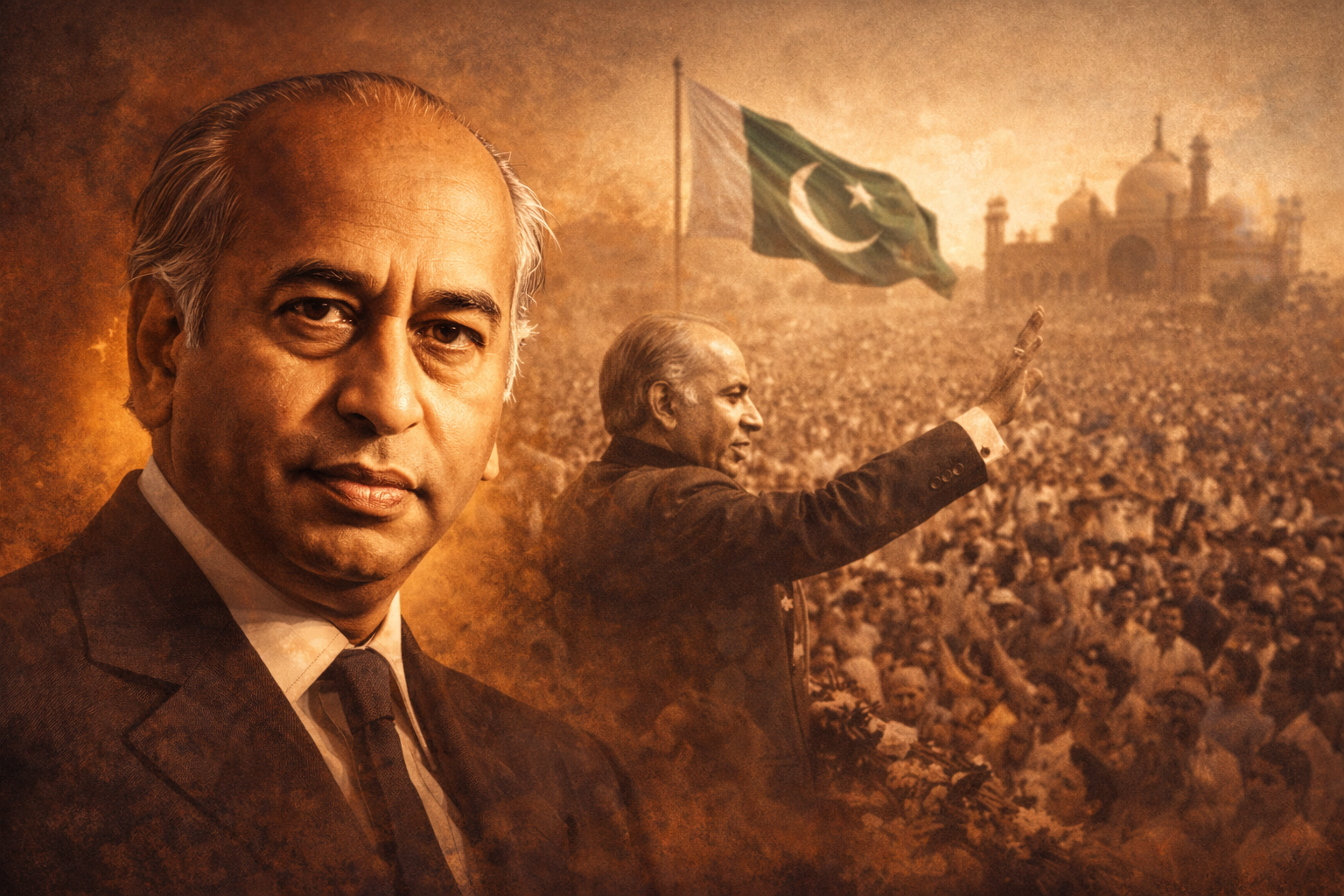
Remembering Zulfikar Ali Bhutto
Earlier today, at a small reunion hosted by a former QAU student(1970’s batch), five old friends gathered; two retired senior civil servants, one visiting from Canada, and another long associated with the Peoples Party. Interestingly, the conversation turned to their personal encounters with Zulfikar Ali Bhutto. They recalled his remarkable memory, magnetic charisma, and unwavering commitment to the welfare of ordinary Pakistanis–qualities that left an enduring imprint on all who met him.
Across generations, within academia, media, and policy circles Bhutto remains one of Pakistan’s most popular modernist and reformist leaders, a statesman with strategic vision. His execution on 4 April 1979 is widely regarded as a judicial murder. Yet, beyond the controversies and personal failings, his legacy endures. As Oxford historian Hugh Trevor-Roper, who knew Bhutto personally, observed, he will be remembered “for the courage and skill with which he led his country out of the greatest crisis; and for the equal courage and dignity with which he bore a protracted and cruel fate.”
Bhutto’s intellectual depth, global exposure, and statesmanship were most evident in his reorientation of Pakistan’s foreign policy. His articulation of bilateralism as its cornerstone remains a lasting contribution: engaging each major power pragmatically, cultivating cooperation without rigid alignments, and grounding policy in “joint perceptions of mutual interest.”( Zulfikar Ali Bhutto: New Directions: A New Edition with Appriasal By Hugh Trevor-Roper, London, 1980) This approach enabled Pakistan to navigate its complex geopolitical environment with dignity, flexibility, and self-respect. This should remain guiding principle of Pakistan’s foreign policy even in today’s unpredictable world order.
In memory, Bhutto endures not merely as a political leader, but as a defining architect of Pakistan’s modern statecraft.
Discussion
Join the conversation. Comments are powered by GitHub Discussions.