
Historiography has come of age in Pakistan. I find the writings of Ilyas Chattaha, Ali Qasmi, Qaum, Mulak, Sultanat: Citizenship and National Belonging in Pakistan (2023) and Tahir Kamran, Chequered Past, Uncertain Future: The History of Pakistan (2024) refreshing, stimulating, strongly interpretive, inviting critical thinking in the broader content of Pakistan Studies. More importantly these historians are raising issues of fundamental importance; who is a citizen? Are our citizens aware of their rights and responsibilities? What happens when the state-citizens relationship is broken? What are State’s obligations to its citizens and how a narrative on national identity may be constructed? These are complex issues with deep, historical, cultural, ethnic and religious overlapping’s and demand deliberation, dialogue and serious reflections among scholars, policy makers and proponents of civil society across Pakistan.
Given this context, in my assessment, Ilyas Chattha’s Citizens to Traitors: Bengali Internment in Pakistan, 1971–74 has three outstanding features; it is trailblazing research on a sensitive and under the rug topic, which disentangles state’s behavior, conduct and break up story. Second, it has uncovered substantive new data, an original contribution; he has dug and used intelligence and police sources with utmost care, academic rigor and assiduousness. Earlier research that I can recall, used similar sources was a study by British historian Patrick French, Liberty or Death: India’s Journey to Independence and Division (1997) who used declassified intelligence files and provided a provocative account of the process of Indian independence and split of British India. Third, Chattaha, has drawn attention towards an issue of pivotal significance; what happens when the state-citizens relationship is broken? He has traced the frequency and casualness with which the term traitor or Ghadar is used by the Pakistani State and becomes part of societal narrative (In his book Ali Qasmi addresses this issue systematically in the broader Pakistani historical perspective).
Citizenship and the Power to Define Treason
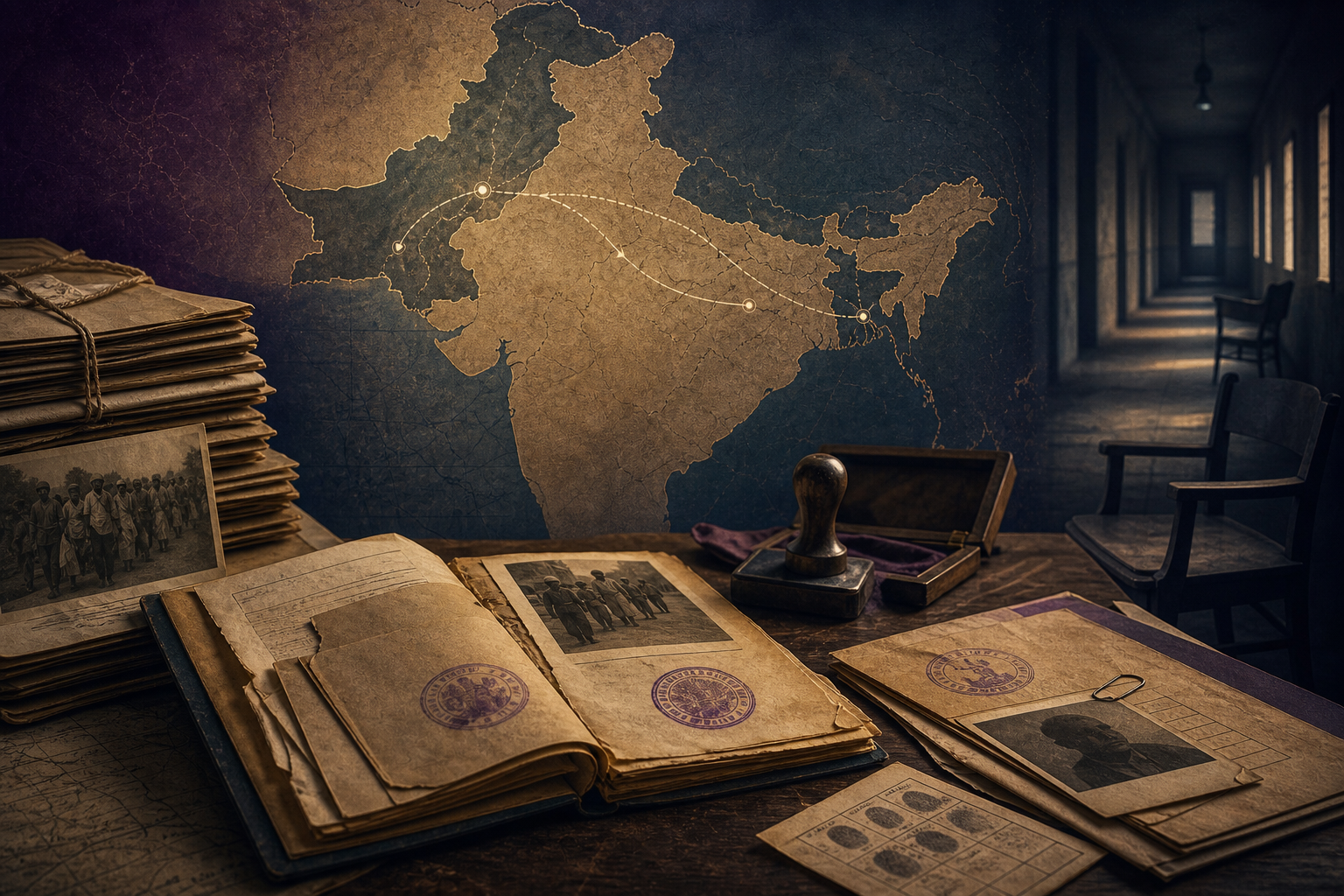
The central argument of Ilyas Chattha’s Citizens to Traitors: Bengali Internment in Pakistan, 1971–74 is that the Pakistan state, confronted with the collapse of national unity in 1971, redefined a segment of its own citizens; the Bengalis of East Pakistan into a category of suspect people who were collectively treated as “traitors”/ Ghadar. Through internment, surveillance, and restrictions on movement, citizenship was effectively suspended. The book is therefore not merely a history of Bengali internees; it is a study of how states redefine citizenship, loyalty, and belonging during times of political crisis.
Drawing on the work of Sharika Thiranagama and Tobias Kelly, Chattha argues that “traitor” is not simply a legal category but a political construction. So, the critical question is not who actually committed treason, but who possesses the power to define others as traitors. To illustrate who has the power define, who is traitor, I have found this report by David Sanger, renowned New York Times (NYT) reporter instructive, who was travelling back from China with President Trump in Airforce , he says I asked the president a question on Iran war and nuclear issue and the president replied by calling the NYT and David Sanger, “treasonous” (NYT 31st May 2026). Following the military crackdown of March 1971 and the subsequent civil war, Bengali identity itself became associated with sedition and disloyalty in the eyes of the Pakistani state. Resultantly, according to Chattha an estimated forty thousand Bengalis living in West Pakistan were perceived less as citizens and more as a potentially inimical population.
Internment and Repatriation
In chapters 2 to 5 Chattha meticulously documents the experiences of Bengali internees who were confined in camps and restricted settlements across West Pakistan. He points out that living conditions were often harsh, uncertain, and degrading, and their family’s experienced separation, economic insecurity, and psychological trauma. Yet an interesting finding of his research is that internment itself was not fully uniform. A hierarchy existed among the internees. Military officers, civil servants, judges, diplomats, and professionals generally received somewhat better treatment than ordinary civilians. Chattha interprets this as evidence that bureaucratic and class distinctions survived even within a system that denied basic citizenship rights. As senior military and bureaucratic personnel represented valuable state assets. The Pakistani state therefore treated them differently because it anticipated that they might eventually become part of repatriation negotiations. Paradoxically, while the state questioned their political loyalty, it continued to recognize their institutional utility. This hierarchy reveals an important contradiction. The state collectively categorized Bengalis as ‘traitors’ and unreliable citizens, yet it simultaneously distinguished among them according to rank, profession, and usefulness. Thus, internment reproduced many of the same social and institutional hierarchies that had existed prior to break up in 1971.
The book’s discussion of “Escape or Die” and “Triangular Repatriation” in Chapters 6 and 7 is among its significant contributions. Chattha describes the complex negotiations involving Pakistan, India, and Bangladesh after the Indo- Pakistan war. These negotiations involved three interconnected groups: approximately 40,000 Bengali internees in Pakistan, more than 90,000 Pakistani prisoners of war held in India, and thousands of non-Bengalis stranded in Bangladesh. Chattha’s implicit observation is that Bengali internees became bargaining tools in a broader diplomatic process. Their fate was linked to the release of Pakistani POWs and to the normalization of relations among the three states. From the author’s perspective, this demonstrates how individuals who should have been treated as citizens with rights were instead converted into objects of political negotiation.
This issue also raises a broader question. Could Pakistan realistically separate the repatriation of Bengali civilians from the fate of its POWs? Let me interpret it from two perspectives; from a humanitarian standpoint, linking the two appears morally problematic. From a realist perspective, however, post-war settlements often involve precisely such exchanges. States usually negotiate over prisoners, displaced persons, and diplomatic recognition as part of a broader political package.
In my view, Chattha’s narrative highlights a tension between morality and statecraft. While he emphasizes the suffering of Bengali internees, one could also argue that Pakistani policymakers faced a difficult strategic situation in attempting to secure the return of their captured soldiers and civilians. The tragedy was that both Bengali internees and Pakistani POWs became entangled in a process driven by political calculations rather than humanitarian principles.
An important analytical distinction in the book is between repatriates and prisoners of war. This distinction goes to the heart of Chattha’s argument. A prisoner of war is a combatant captured during armed conflict and protected under international law. A repatriate, by contrast, is a civilian citizen who is returned to his or her country after displacement or confinement. The Bengali internees were not enemy soldiers captured on a battlefield. They were citizens of Pakistan. Yet they were treated in ways that often resembled the treatment normally reserved for wartime prisoners. This blurring of categories illustrates the central theme of the book: citizens were transformed into people whose rights could be suspended and who were labeled as ‘traitors’ and their status became uncertain. The significance of this distinction becomes clearer after the creation of Bangladesh. Many Bengali internees suddenly found themselves belonging neither fully to Pakistan nor yet fully to Bangladesh. They occupied an ambiguous position between two states. Their experience demonstrates how the collapse of one political community can leave ordinary people stranded between competing definitions of citizenship and national identity (see chapter 5).
Yet another original contribution of the book is its analysis of the post-independence Bangladesh military. Chattha identifies a struggle between two groups of officers whose legitimacy derived from different experiences of 1971.The first group consisted of officers who joined the Mukti Bahini and fought for Bangladesh’s independence. Their authority rested on participation in the liberation struggle and on their role in the founding of the new nation. The second group consisted of officers who had remained in West Pakistan, experienced internment, and later returned through repatriation. Many of these officers possessed superior professional training, longer service records, and higher ranks. Some eventually rose to the level of Major General and Lieutenant General within the Bangladesh Army.
The resulting tension reflected two competing sources of legitimacy. Liberation officers claimed moral authority because they had fought for independence. Repatriate officers emphasized professional competence, organizational experience, and military expertise. This struggle was therefore about more than promotions or institutional influence. It reflected competing memories of the birth of Bangladesh itself. One side represented revolutionary legitimacy; the other represented professional military continuity. In fact, this tension has been eloquently captured by Professor Naeem Mohaiemen in the Foreword of the book, who perceptively observes that these tensions became an important feature of civil-military relations and military politics in the early years of Bangladesh (p. xviii)
Memory, Silence, and Belonging
The book’s concluding chapter moves beyond internees’ history and explores the relationship between memory, trauma, and silence. For Chattha, silence is not simply the absence of speech; it is itself a historical phenomenon that requires explanation. Many former internees chose not to discuss their experiences. Humiliation, displacement, uncertainty, and violence often left psychological scars that survivors found difficult to articulate. Families likewise avoided revisiting painful memories. As a result, much of the history of Bengali internment remained hidden from public discussion. Chattha argues that this silence also operates at the national level. In Pakistan, public memory of 1971 has generally focused on military defeat, the loss of East Pakistan, and the fate of Pakistani POWs. In Bangladesh, the dominant narrative emphasizes liberation, resistance, and nation-building. The experiences of Bengali internees in West Pakistan fit comfortably into neither narrative. Consequently, these individuals occupy a marginal place in the historical memory of both states. It is worth remembering, when suffering is neither acknowledged nor incorporated into collective memory, it does not disappear, it continues to shape identities, perceptions, and historical grievances. The past remains buried but not forgotten. For Chattha, recovering these suppressed stories is therefore not simply an academic exercise. It is a means of restoring dignity to individuals whose experiences were overlooked by official histories.
Concluding Thought and Takeaways
Three important take aways from, Citizens to Traitors are: First, at its core, it is a study of the tenuousness of citizenship during periods of state breakdown. Chattha demonstrates how quickly citizens can become suspects, how ethnic identity can override legal rights, and how ordinary people can become instruments of political bargaining during and after war.
Second, the book shows that the internment of Bengalis was not merely a humanitarian episode arising from the 1971 Indo- Pakistan war. It was the culmination of a deeper political rupture in which mutual trust between state and citizens had already collapsed. The Pakistani state increasingly viewed Bengalis as disloyal, while many Bengalis had ceased to regard the Pakistani state as representing their interests. Citizen’s lack of trust in the State remains a troubling issue even in today’s Pakistan.
Finally, Chattha’s work is not only about the suffering of Bengali internees. It is also about the power of the State to redefine belonging, the vulnerability of citizenship in times of crisis, and the enduring consequences of silenced histories. By recovering these ignored experiences, the author challenges both Pakistan and Bangladesh to confront ‘chequered past’ that remain politically uncomfortable but historically essential. The book is a must read for all those who want to understand the breakup of Pakistan, violation of citizens’ rights and aim to contribute towards building a humane and citizen trustworthy Pakistan.
Also available: https://www.thefridaytimes.com/02-Jun-2026/citizens-traitors-fragility-citizenship-pakistan
Discussion
Join the conversation. Comments are powered by GitHub Discussions.