
We have been witnessing humanity die in front our eyes in Gaza and yet we also persist and survive with our analysis and here I am!!
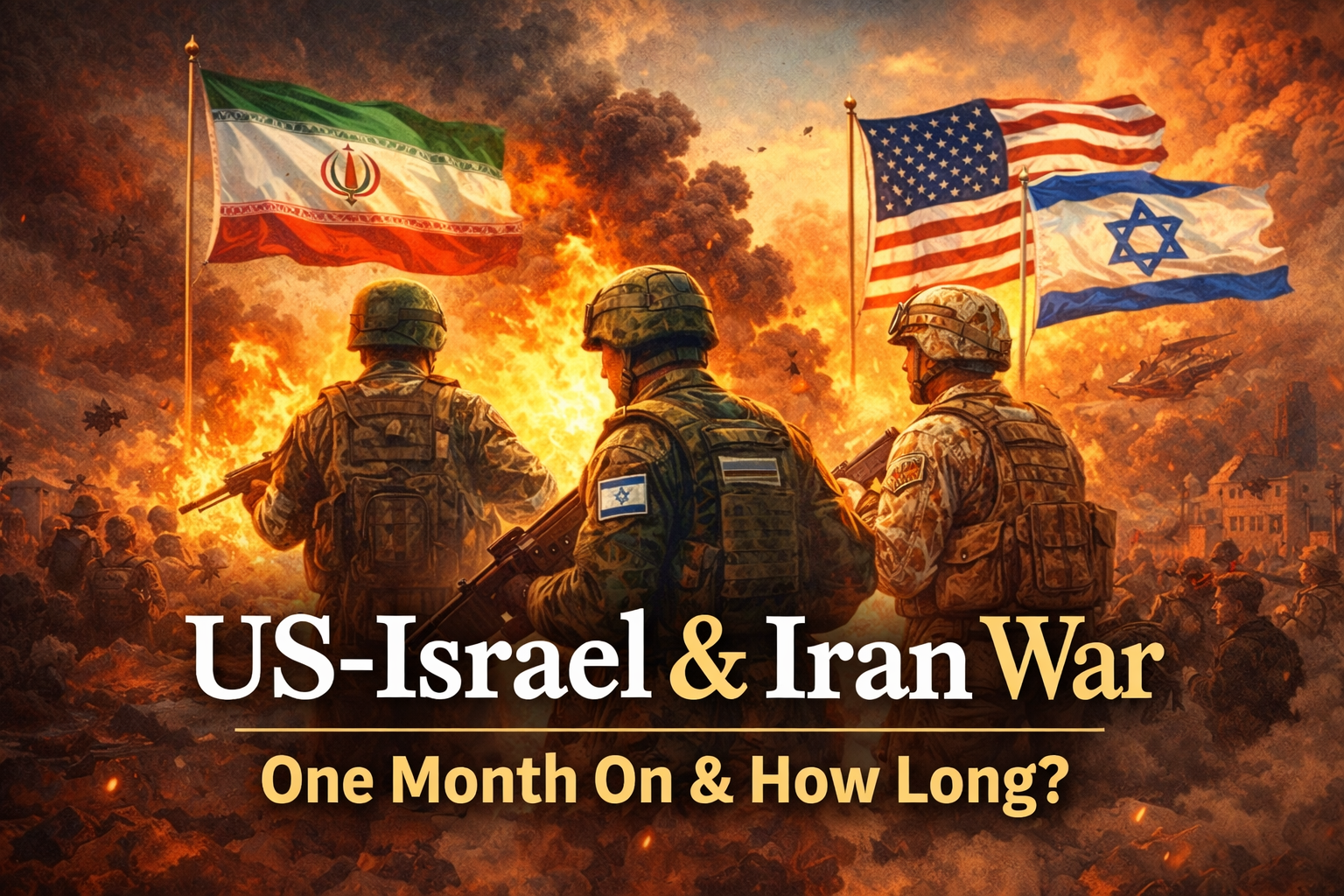
The US–Israel–Iran war has now entered its second month, with mounting lethality, staggering human costs, and widening repercussions for the global economy. The international system increasingly resembles a self-help order: major powers such as China and Russia are treading cautiously, unwilling to directly confront US–Israeli military dominance. This restraint is not merely strategic but also economic—evident in China’s deepening ties with Israel, including bilateral trade exceeding $15 billion in 2023 and infrastructure investments surpassing $12 billion.
Core Problem:
At the core of the Middle East’s enduring instability lies Israel’s militarized and expansionist posture. Since the June 1967 Arab–Israel war, Israel has annexed, occupied, and consolidated control over territories belonging to Syria, Jordan, Egypt, the West Bank, and parts of Lebanon. These actions not only redrew territorial boundaries but also catalyzed and sustained resistance movements across the region. The long-term consequence of the 1967 war was twofold: it incapacitated Arab nationalism and enabled Israel to pursue a gradualist strategy of territorial consolidation.
Since Henry Kissinger’s shuttle diplomacy in the early 1970s, US policy has consistently aimed to preserve Israel’s qualitative military edge, entrenching its regional primacy. Recent developments reinforce this trajectory. Following the October 2023 ruthless Hamas attack on Israeli civilians, Israel’s military response has escalated sharply, raising serious concerns about proportionality and compliance with international law.
What Israel Needs to Do?
Given this context, a recalibrated international approach is imperative. First, Israel must be pressed to adhere to international law, including respect for sovereignty, human rights, and the laws of armed conflict. Second, it should be urged to withdraw from occupied territories and return to pre-1967 boundaries as a basis for durable peace. Third, transparency regarding its nuclear capabilities and accession to the Nuclear Non-Proliferation Treaty (NPT) are essential for regional stability.
Meanwhile, the Gulf states—despite hosting US military bases—remain structurally insecure. Their participation in the Abraham Accords reflected short-term expediency rather than strategic foresight, a pattern that appears to persist in their evolving security alignments(Defense agreements with Ukraine).
The current US–Israel strategy toward Iran suggests objectives that go beyond deterrence, pointing toward regime change, leadership decapitation, and institutional dismantling. Diplomatic signaling notwithstanding, large-scale US troop mobilizations indicate a high risk of further escalation, with potentially devastating regional and global consequences.
Concluding Thought:
In sum, de-escalation requires a shift in international focus: engaging and containing Israel’s militarism, ensuring its withdrawal from occupied territories, enforcing compliance with international law, and advancing a viable two-state solution that recognizes Palestinian statehood. Without such a reorientation, the cycle of conflict is likely to intensify, with profound human and systemic costs.
Discussion
Join the conversation. Comments are powered by GitHub Discussions.