“War made the state, and the state made war.” Charles Tilly
In reflecting on the formation and evolution of modern European states, Tilly underscored the significance of violence and organized coercion in state-building. War has not merely shaped borders; it has rearranged institutions, consolidated authority, and forged national identities.
Why It Matters
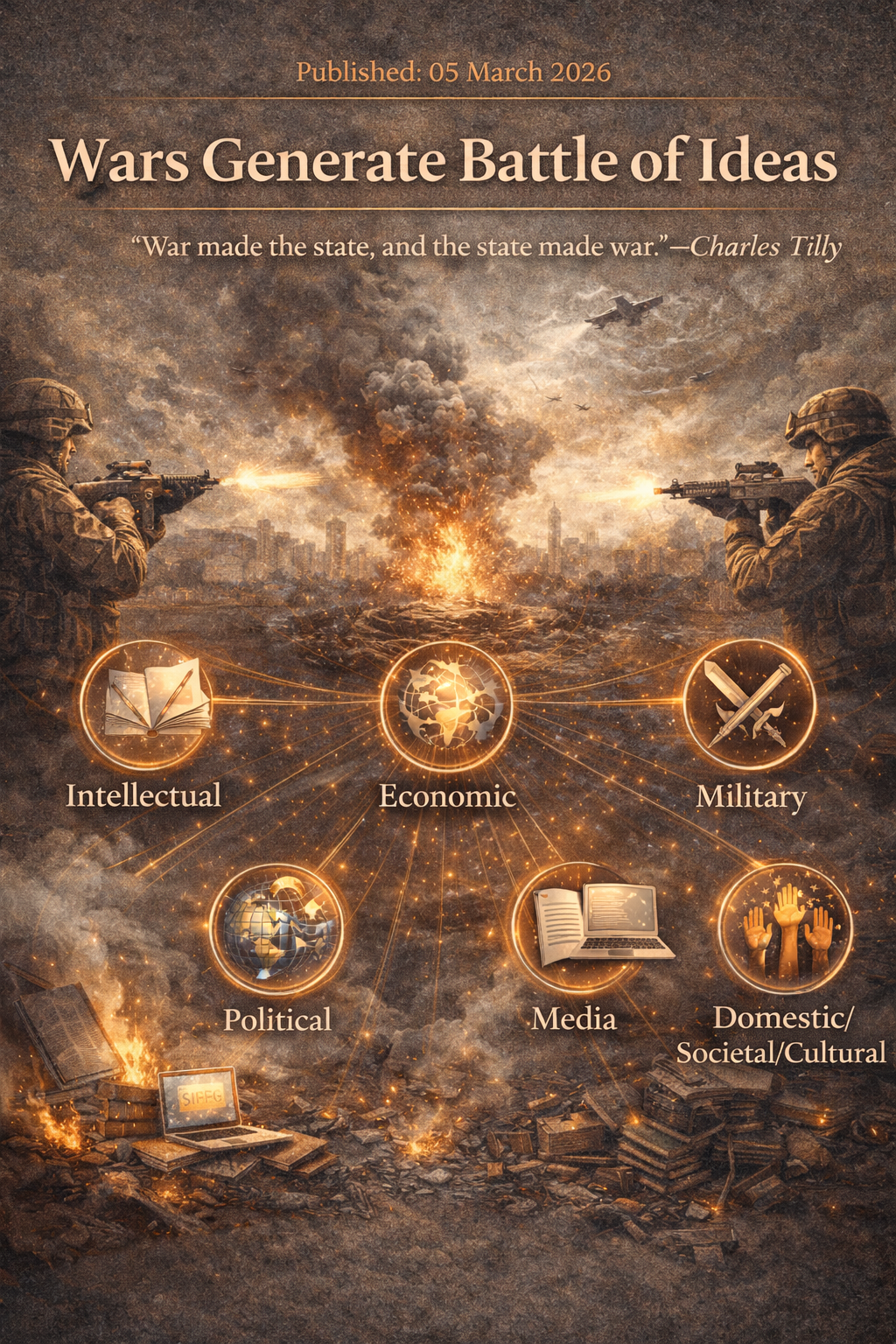
Wars also generate battles of ideas. In my view, modern wars are fought across six interrelated fronts:
- Intellectual Front: the struggle over narratives, legitimacy, knowledge production, and strategic discourse.
- Economic Front: sanctions, supply chains, financial systems, trade regimes, and technological control.
- Political Front: diplomacy, alliances, institutional hedging, and regime positioning.
- Military Front: conventional and unconventional maneuvers, deterrence, and strategic signaling.
- Media Front: social, print, electronic, cyber, and AI-driven information domains where perception often equals firepower.
- Domestic/Societal/Cultural Front: the internal cohesion of a society, whether polarized or pluralist, fragmented or consensus-driven.
What Are the Implications?
War does not simply preserve or destroy states; it can make or break nations by testing resilience, institutional depth, and national will.
Today we are witnessing warfare that is increasingly lethal, often apathetic to legal norms and human life, and capable of distorting or obliterating truth itself. For researchers and policy analysts, the imperative is clear: never abandon the search for truth. Facts endure, even when policies shift and narratives oscillate.
I would be interested to know whether this framework helps you analyze the dynamics of ongoing war in the Middle East and beyond.
Discussion
Join the conversation. Comments are powered by GitHub Discussions.